

Hi Ren: A Magnum Opus of Jungian Shadow Work
Ren wrote his magnum opus “Hi Ren” about his unraveling. Misdiagnosed with bipolar disorder, later found to have Lyme disease, he was caught in a psychosis. But of that collapse came one of the most precise Jungian portraits of shadow work ever set to music.
Hi Ren is a complex work of art that combines sophisticated musicality, composition, theater, poetics, and an amalgamation of genres.
The Intro
The artist’s performance begins with the unity of disparate musical parts and a reflection of harmony amidst dissonance in the guitar and falsetto sounds.
As it continues, it reveals Jungian shadow work in action and the alchemical journey of individuation, the lifelong process of integrating conscious and unconscious into a coherent self.
What follows reveals how that alchemy plays out across the performance, musically, lyrically, and psycho-spiritually.
The Battle
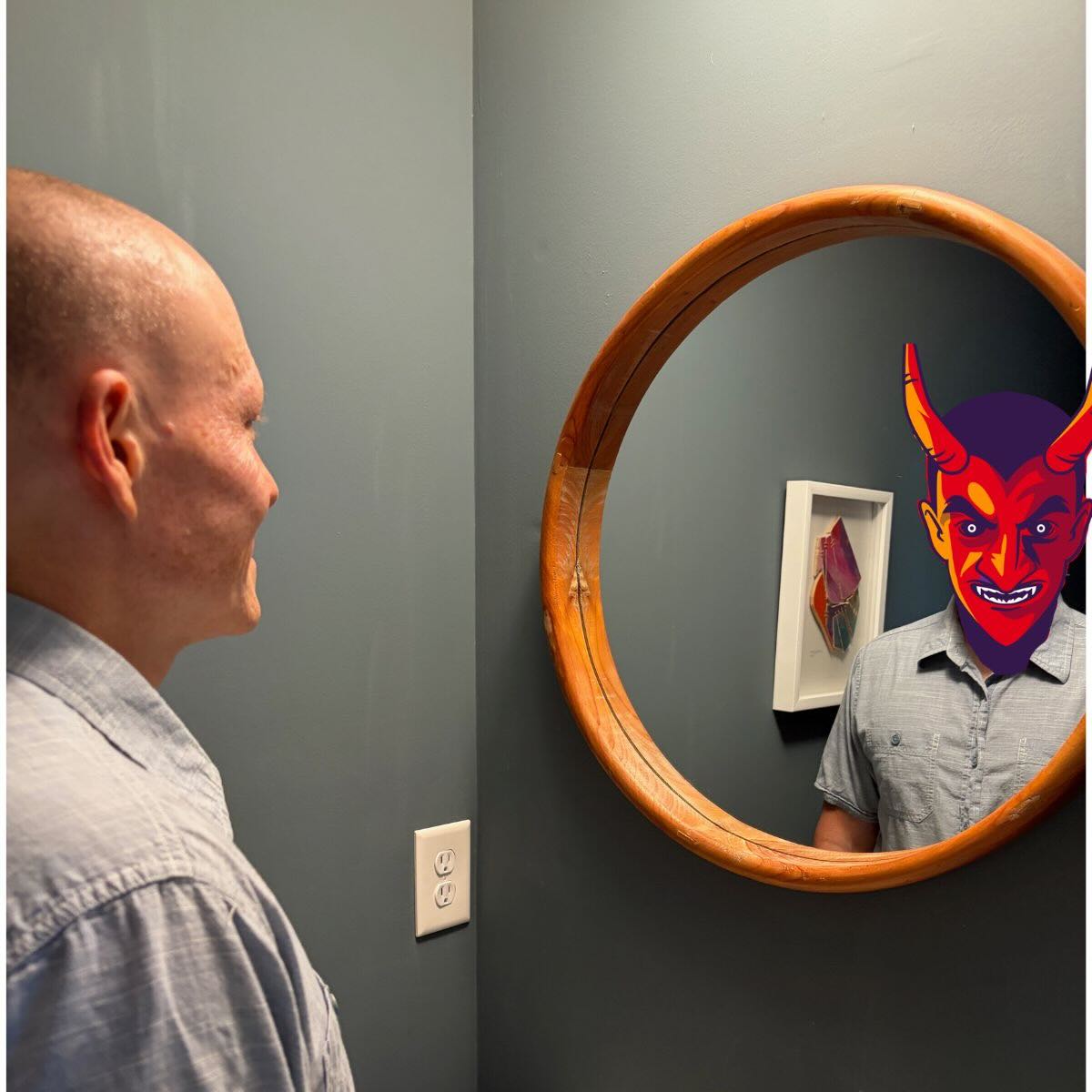
The musical unity devolves into the duality of opposing characters, the shadow in the form of an aggressive and punitive inner critic with an agenda to control and a defended ego trying to create distance from it.
The critic raps with a harsh and forced tone and is accompanied by a harder driving percussive rhythmic guitar style, while the more passive part speaks with a softer voice and plays a more melodic and spacious sound on the guitar.
With increasing intensity musically, lyrically, and emotionally, the performance shows that trying to bury or repress the shadow material only strengthens it. Ren’s critic more harshly and aggressively sows self-doubt, imposter syndrome, shame, and guilt.
The unconscious is relentless in its efforts to get our attention. And the opposing forces reveal the imprisonment of one-sidedness.
The Magnum Opus and Alchemical Transformation
“Magnum opus” is usually shorthand for an artist’s greatest work. But alchemists used the same term for the entire process of transformation itself, the “great work” of turning lead into gold. Ren’s performance is a magnum opus in both senses at once.
His attempt to totally eliminate the critic by ingesting it turns the performance ever darker, numinous, and archetypal as the devilish darkness exhibits the timelessness and raw power of the shadow in unconsciousness.
Jung saw synchronicity between the alchemical process and psychological growth and suggested that the alchemists projected their psyches onto the materials they worked to transmute.
Nigredo
The initial phase of alchemy, Nigredo indicates suffering and darkness. Ren’s performance up to this point has been marked by chaos and regression of the alchemical stage of Nigredo, where the shadow is pulled into ourselves.
As the intensity reaches its zenith, the discordant sounds crescendo up the guitar neck to emphasize the tension and the darkest part of the performance.
A captive audience to his own darkness, Ren then moves down the fret board of the guitar with the music descending into a new stage.
Albedo
In this stage, the materials are purified and something clearer remains. Psychologically, Albedo occurs when one accepts the shadow and gains clarity about how the shadow took over parts of one’s life.
Having listened to the shadow’s claims, Ren’s darkness burns away and Ren is left with his essence.
Earlier in the performance the harsh rapping shadow figure highlighted the singer’s shadow material, specifically his desires to be: “a big deal,” “the next Jimi Hendrix,” “interviewed by Oprah,” and “recognized by a Grammy award.”
Additionally, Albedo portrays Ren’s acknowledgement of his capabilities for darkness, criticism, judgment, harshness, and aggression.
Having confronted the shadow, he responds with compassion for himself, highlighting the integration of it.
Rubedo
Rubedo is where, alchemically, “lead” becomes gold. It is the philosopher’s stone where the union of opposites manifests a coherent Self.
In this stage of the performance, Ren softens his rigid stance against the critic and speaks with a different timbre and tone.
He then builds with resilience as he acknowledges his time in the crucible and rises up from the wheel chair that has been supporting him in his illness. He stands confidently there, supported by his spirituality and a different kind of power: hope.
The singing shifts again into a reggae-esque wail with stability and an intensely rhythmic strumming. Having incorporated and integrated the shadow, he acknowledges the twinship of their duality as “a coin with two different sides.”
The Dance
Ren has transmuted the battle into a dance in which he flows with the sways of the pendulum back and forth dancing between dark and light.
The dance reveals the third thing birthed from the tension of the opposites, the philosopher’s stone which represents the synthesis of the two.
In the performance, Ren plays a rhythmic guitar style and returns to his falsetto to resolve the duality full circle. The concluding monologue reveals that it was in learning to dance that he was able to relax into the point of healing and growth.
Dancing instead of fighting, Ren reveals a further individuation of the Self, resilient and confident amidst the fires and storms he has sung about.
Our shadows want expression, and Ren used his art to create with his. His work is a magnum opus, having projected his psychic state into his embodied performance and turned the lead of his illness into gold.
Hi Ren has tapped into the collective, and offered a message of hope, healing, and wholeness.
The message continues to evolve as an inspiring call to follow the artist on this path, the same path from hell Jung himself trod on his own journey from illness, a journey of learning to dance with the shadow.
Next Steps
Ren’s transformation happened through crisis and art. Most of us won’t face that kind of reckoning, but the same Jungian shadow work is available to anyone willing to look.
Therapy
Psychotherapy is an opportunity to explore the shadow material we have been repressing or otherwise hiding from ourselves.
Together with a therapist, you can engage the alchemical process of individuation so you may reconcile the disparate, warring parts of yourself.
I work with folks on the path towards finding the healing and growth available on the journey toward their true Selves. Let’s talk about how therapy might address your concerns.
Schedule a free 15-minute consultation to see if this is a good fit.
Active Imagination
What Hi Ren depicts is a process available to all of us when we are willing to incorporate our shadow material into conscious awareness.
It is advised to have a therapist with whom you can process what you encounter in active imagination.
We do not have to go through the horrors of illness and/or the debilitation of medicating what Ren has called a misdiagnosis to reach a point of healing and growth, but it does take honesty and a willingness to see what we’ve been hiding from ourselves for all of these years.
Jung used and encouraged others to do what he called active imagination, a process of creatively engaging the unconscious through various forms. For instance, one of which could be a dialogue journaled back and forth between the shadow material and yourself.
And by answering for both yourself and your shadow material without overthinking the responses from the unconscious, you can tap into what it wants you to know.
Importantly, it is a must to do active imagination with respect for the power of the unconscious, otherwise it will not participate helpfully. Remember it is not a battle, but a way to learn to dance with your once-repressed shadow.
Further Reading
Murray Stein has recently published a book called Jung and Alchemy: A Path to Individuation published by Chiron Publications.
You can listen to a podcast of three Jungian analysts describe Jung’s take on alchemy and read its accompanying article at This Jungian Life.